
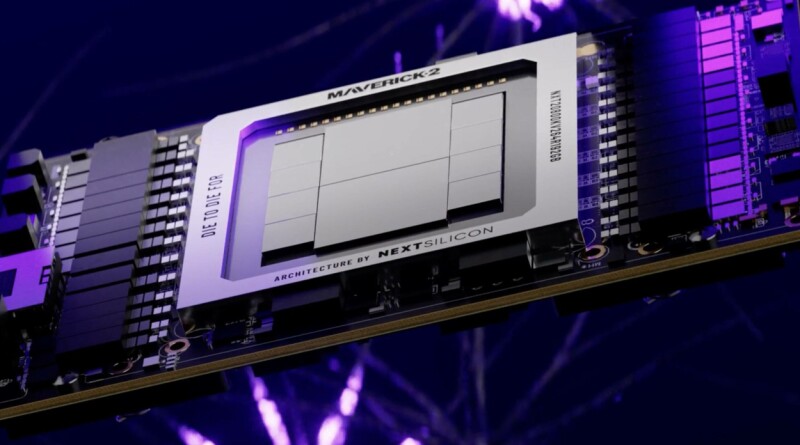
The US Department of Energy (DoE) is deepening its relationship with HPC-first chip startup NextSilicon.
During Supercomputing 2026 in Chicago on Monday, the Israeli startup revealed that the agency had deployed its second Maverick-2 cluster in the Darwin testbed at Los Alamos National Laboratory (LANL).
The deployment comes just six months after Sandia National Laboratories powered on NextSilicon’s first supercomputer, which features 64 nodes and 128 of the company's “runtime-configurable” accelerators.
NextSilicon’s latest DoE system is comparatively smaller, comprising just four accelerators, yet for LANL, the system is arguably more important despite its size.
Darwin, LANL’s chief scientist Galen Shipman, tells El Reg is a “long-lived testbed environment where we bring in newer technologies for evaluation.”
“It gives us the ability to work with the technology much more quickly, and integrate it with other components of our architecture in our environment,” he explained.
Smaller systems like the Maverick-2 cluster now deployed in Darwin allow LANL to validate and port a wider array of codebases to the chips, identify problems, and work with NextSilicon to not only address them, but directly influence the capabilities of future chips, Shipman explained.
In other words, Los Alamos’ interest in Maverick-2 is the first step toward larger scale deployments of NextSilicon silicon in future DoE supers. For this, hands-on access is kind of important as many of LANL’s most important workloads can’t exactly be run on public systems.
LANL is one of several labs tasked with ensuring that the US’ nuclear deterrent remains effective decades after underground testing was banned. The lab is also responsible for running simulations on energy sources like fuel candidates for future fusion reactors. Both of these workloads, Shipman tells us, fall into a category called multi-physics simulations.
These workloads aren’t really one workload, but multiple simulations that can have wildly different compute requirements.
A “good example is inertial confinement fusion. At the National Ignition Facility at Lawrence Livermore National Laboratory, you're using lasers to implode a fuel capsule, and the goal is to generate more energy through yield than you do from depositing energy to the capsule,” Shipman explained. “That's inherently multiphysics.”
There are simulations for the lasers, the hydrodynamics within the fuel capsule, and the chemistry and material interactions taking place during the fusion process. The problem, Shipman explains, is that a system that’s ideal for one of those simulations may not be well suited to others. “Identifying one specific platform that is optimal for that type of simulation is challenging.”
CPUs, he says, are well suited to workloads with large serial sections, irregular access patterns, and jobs that benefit from deep cache hierarchies. Meanwhile, GPUs are fantastic for dense, matrix-multiplication heavy workloads.
"Where NextSilicon fits in is being able to reconfigure to match the workload, on demand,” Shipman said. “The hope is that we won't have to make these rigid determinations upfront like, ‘we need this much CPU or we need this much GPU.’ We can use a much more adaptable, reconfigurable architecture to meet the workflow where it is at.”
Despite some visual similarities to Nvidia’s current crop of GPUs, Maverick-2 is not a GPU. Instead it employs a dataflow architecture which overlaps communication and computation. Rather than waiting for load-store operations to shuffle data around as you would with a conventional CPU or GPU, the chips themselves comprise a grid of arithmetic logic units (ALUs) which are configured to perform an operation like addition or multiplication in the order that they’re needed.
Data is computed as it moves from one ALU to the next, a bit like how a ball moves through a Rube Goldberg contraption.
This can make dataflow architectures extremely efficient in bandwidth-bound scenarios, which has implications not only for HPC and scientific computing but also for AI. It’s why we’re seeing dataflow accelerators, like Nvidia’s Groq, Cerebras’ WSE-3, and SambaNova’s SN50, being deployed as decode accelerators in AI inference clusters. Where NextSilicon stands out is that its designs, so far, have been specifically tailored toward sparse double-precision FP64 workloads.
Programming dataflow architectures, historically, has been a challenging endeavor. To overcome this, NextSilicon claims to have developed a compiler that can decompose any existing C, Python, Fortran, or CUDA codebases into a graph that can run directly on its chips.
So far, NextSilicon has managed to validate its systems against the High Performance Conjugate Gradients (HPCG) benchmark, the LAMMPS molecular dynamics test suite, and the Sparta Monte Carlo simulation suite.
But as NextSilicon CEO Elad Raz notes, the roofline performance of Maverick-2 is different from one workload to another, and so the company has opted not to advertise peak theoretical performance the same way GPU vendors like Nvidia or AMD have traditionally done.
That’s not to say NextSilicon is shy about Maverick’s performance characteristics. Rather than advertising peak performance that the chip may not be able to hit in the workloads its customers actually care most about, it published performance figures across a swath of HPC benchmarks. For example, in HPCG, one of the closest watched HPC benchmarks after High Performance Linpack (HPL), NextSilicon says a single Maverick achieves 600 gigaFLOPS of performance, which it says is on par with contemporary GPUs but at half the power.
That’s just fine and dandy as far as Shipman is concerned. He tells us peak advertised performance is rarely a useful proxy for real-world performance.
“The thing that my team spends the most time on is how do we generate representative proxies, representative kernels; how do we generate specifications that communicate our needs to the broader ecosystem so that vendors like NextSilicon can meet us and co-design with us.” ®


